Stinging insect pressure in southern Warren County spikes from late June through October as colonies expand toward peak reproductive capacity. Mature colonies of Vespula germanica and Vespula maculifrons establish…
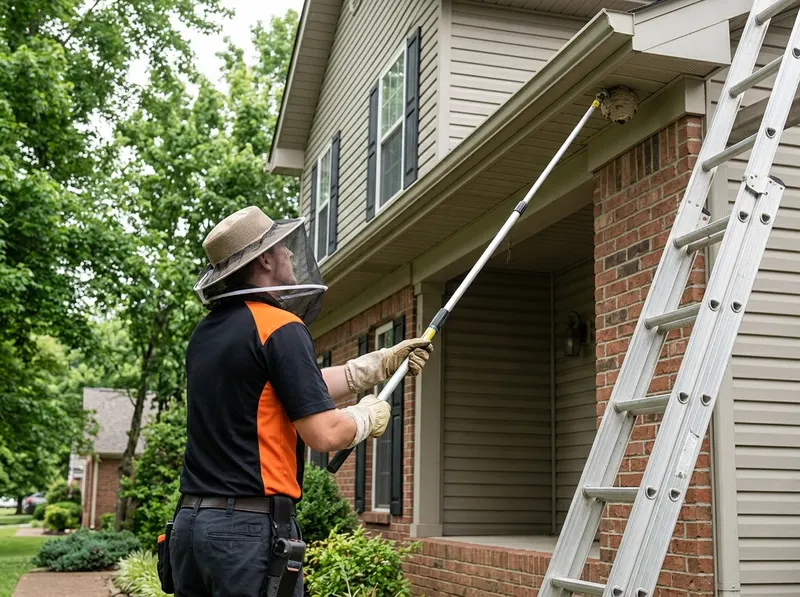
Stinging insect pressure in southern Warren County spikes from late June through October as colonies expand toward peak reproductive capacity. Mature colonies of Vespula germanica and Vespula maculifrons establish subterranean cavities in loose soil near Indian Hills and Briarwood landscaping, while Polistes paper wasps construct umbrella-shaped brood combs beneath the aluminum fascia and covered porch ceilings of Hartland and Olde Stone homes. Unlike simple honeybee swarms, which warrant local beekeeper extraction, aggressive social wasps defend structural territory through repeated venomous stings that cause acute localized trauma or severe systemic reactions. The trade-off between retail spray cans and technical clearance comes down to spray velocity and nest penetration: standard aerosol solvents trigger defensive flight dispersal toward nearby windows and children's play areas, whereas industrial misting delivery neutralizes the guard caste at the nest portal instantly without inciting wide perimeter attacks.
Cavity-dwelling yellowjackets presenting behind exterior brick weep holes or wood siding in Whispering Hills and Fairview properties require directional residual dust injection rather than exterior liquid spraying. Sealing an active entrance hole with silicone or expanding foam before destroying the internal queen forces worker wasps through interior drywall seams, electrical outlet plates, and recessed lighting fixtures directly into living areas. Technicians utilize non-repellent dust formulations containing synthetic pyrethroids or diatomaceous carriers applied at low pressure (20 to 30 PSI). The returning foragers track the particles directly into the central comb core, terminating the brood and queen within 24 to 48 hours without causing structural drywall destruction.
High-elevation baldfaced hornet nests situated 15 to 35 feet up in deciduous canopy lines or roof peaks near Covington Grove and Shawnee Way necessitate telescoping pole application systems combined with positive-locking collection nets. Treatment plans do not require recurring 12-month pest control contracts. Each intervention functions as an independent, single-event clearance focused strictly on the identified biological hazard. Residual insect growth regulators applied to the cleared substrate prevent secondary founding queens from reconstructing nests in the identical soffit corner during the same breeding season.
Every job gets a firm, written price after a free on-site visit.
Tell us about your stinging insect and wasp nest removal job in Bowling Green and we'll send a clear, written quote, usually the same day.
 Zorvilo Pest Control