A crawlspace encapsulation pest barrier creates an airtight mechanical envelope across the earthen floor and vertical masonry walls of a home, decoupling indoor subfloors from the high water tables of South Central…
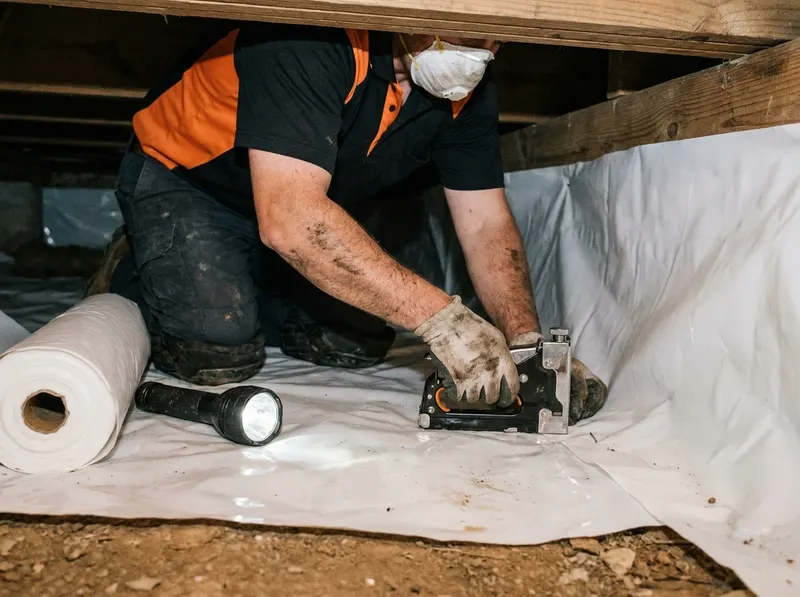
A crawlspace encapsulation pest barrier creates an airtight mechanical envelope across the earthen floor and vertical masonry walls of a home, decoupling indoor subfloors from the high water tables of South Central Kentucky. In Bowling Green neighborhoods like Whispering Hills, Fairview, and Browning, homes built over open-dirt crawlspaces routinely record subfloor humidity levels above 70%, creating ideal harboring conditions for wood-boring powderpost beetles, subterranean termites, and severe mold colonies. Installing a 12-to-20 mil polyethylene reinforced membrane stops capillary ground moisture, dropping relative humidity below the 55% threshold required to halt wood-decaying organisms. This physical envelope prevents damp soil burrowing by rodents and denies harborages to dense populations of cave crickets that otherwise track upward into residential ductwork and floorboards.
Properties situated near the limestone sinkhole formations of Lost River Cave or within the karst river valleys flanking the Barren River face severe seasonal hydrostatic pressure. Unsealed foundation vents allow outdoor air to collide with cool crawlspace air, condensing liquid moisture across sill plates and band joists in Hartland, Olde Stone, and Covington Grove homes. Structural pest clearance in these conditions requires sealing perimeter foundation vents with solid closed-cell foam blocks, wrapping all interior load-bearing piers, mechanically fastening the barrier 6 inches below the top edge of the masonry with poly-faced pins, and sealing every seam with chemical butyl tape. An explicit 3-inch inspection gap is maintained below the sill plate to permit direct visual tracking of mud shelter tubes constructed by subterranean termites, adhering strictly to Kentucky structural pest management codes.
Choosing between simple crawlspace clearing and complete encapsulation depends on measured wood moisture content. If structural floor joists test below 14% moisture and the issue is restricted to transient perimeter rodents, targeted bait stations and exterior exclusion bands resolve the entry point at lower cost. If wood moisture content registers above 18% to 20% in Indian Hills, Briarwood, or Shawnee Way properties, over-the-counter chemical sprays and temporary floor traps fail because persistent moisture continues to draw new colonies of wood-destroying insects and nocturnal rodents. Complete encapsulation converts the unconditioned, contaminated crawlspace into a clean, dry mechanical zone, reducing the heating and cooling load on ductwork by up to 15% while removing the biological moisture engine that sustains recurrent structural infestations.
Every job gets a firm, written price after a free on-site visit.
Tell us about your crawlspace encapsulation pest barrier job in Bowling Green and we'll send a clear, written quote, usually the same day.
 Zorvilo Pest Control